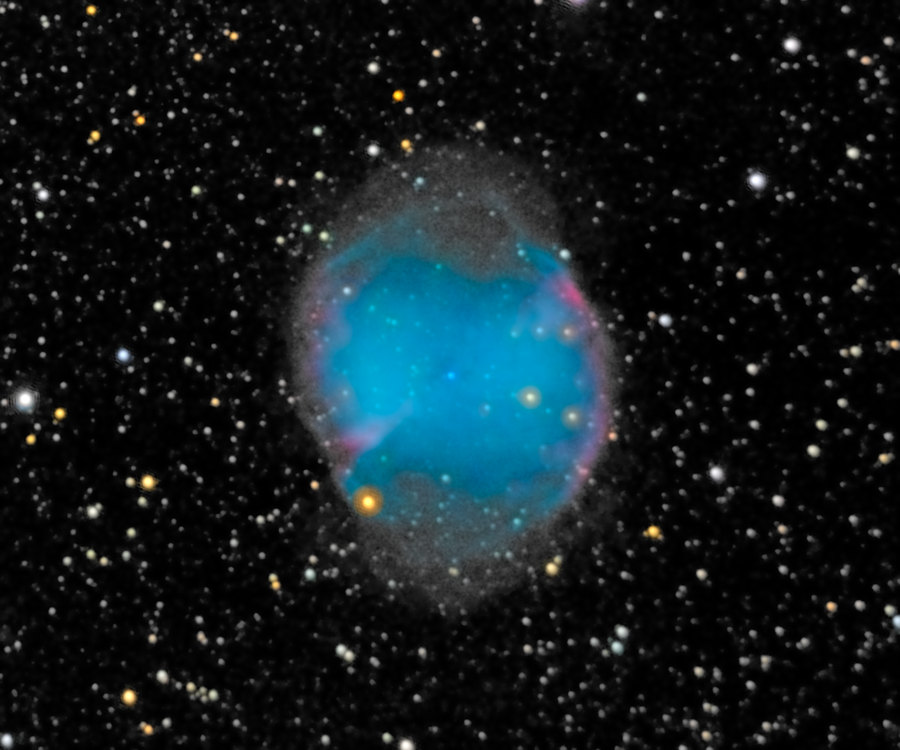
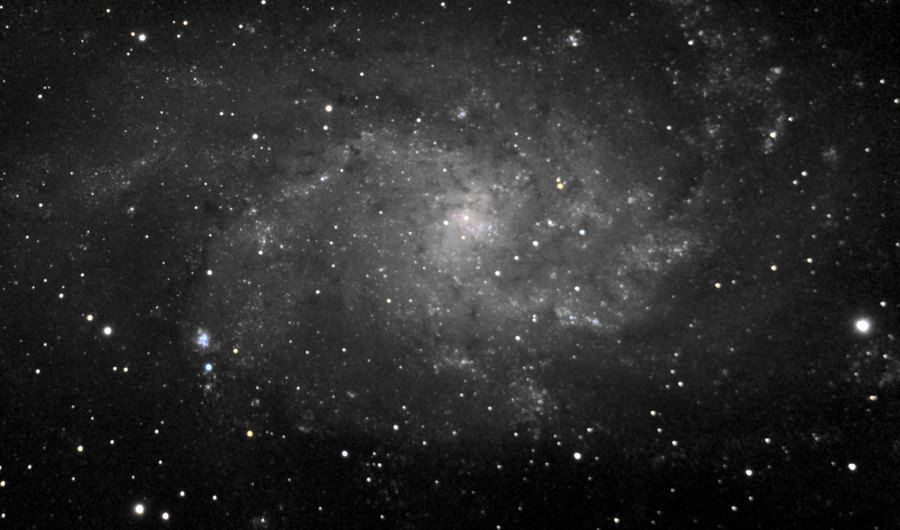
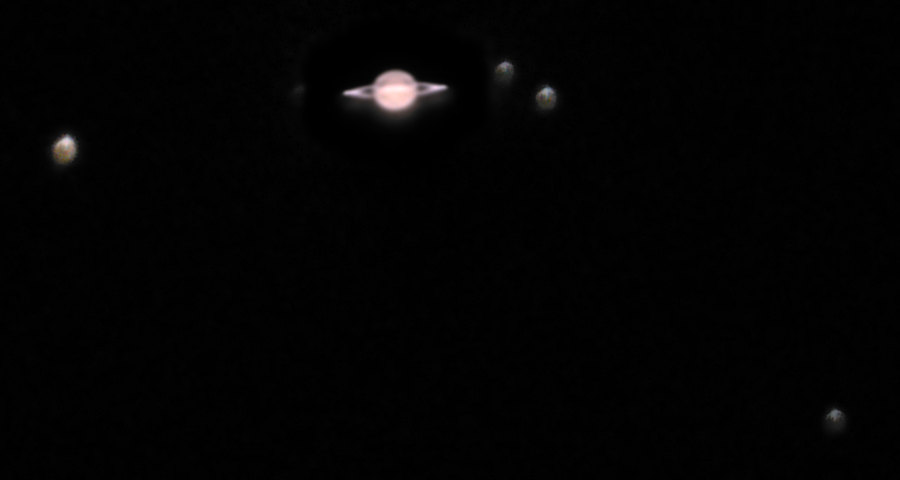
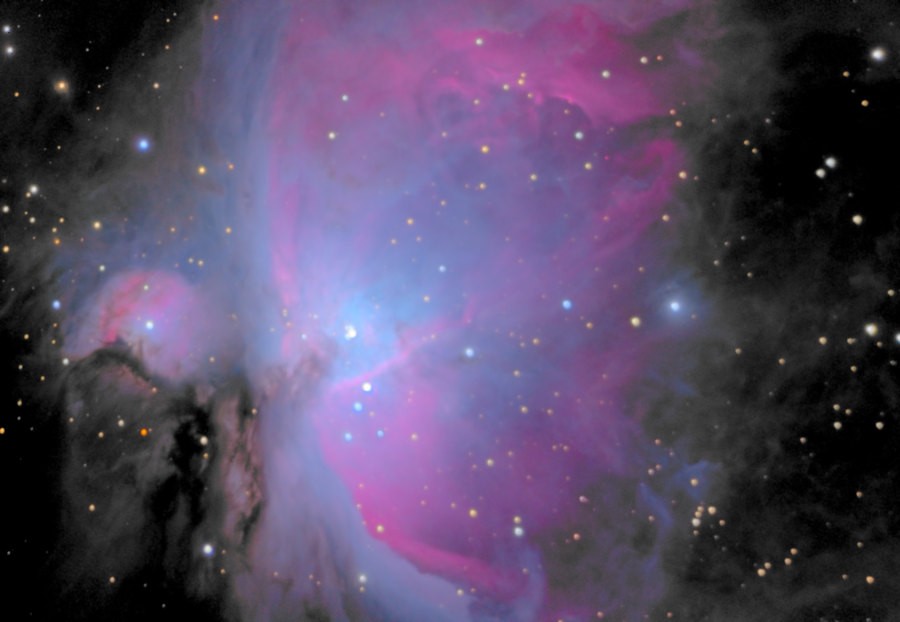
Last week the telescope worked through eleven targets in a night and got a few minutes of light on each. This time it went the other way: four targets and as long as the night allowed on each. The Orion Nebula got an hour and a half.
The night started late. The focus was off, which nothing in software can fix, so the first hour went to setting the telescope up on Vega and reading star sizes off each picture while I turned the focus knob, from 12 arcseconds down to 5. Then the Triangulum Galaxy was still behind a tree, so the telescope went to the Dumbbell Nebula, high overhead, until the galaxy climbed clear.
Out at the telescope I saw dark spots on the camera's screen that looked like dust. They were: the same specks sat in the same places in pictures of two different objects. So from then on the telescope moved a little between pictures, and stacking averaged the dust away. Saturn came next, two hours of short pictures around its highest point, then the Triangulum Galaxy again, then Orion until dawn.
The telescope wasn't parked when it finished. Nothing was set to do it, so it stood there unparked after sunrise. From the next night on, the telescope parks itself.
The problems we ran into along the way are written up as technical notes, below.
Photography notes
The equipment for the whole night, what went wrong at the telescope and what we did about it, and the software. Each picture's exposures and processing are at the foot of its own page.
- Location
- San Francisco Bay Area. A driveway at home, with trees on most sides
- Telescope
- Celestron 8SE Schmidt-Cassegrain. 203 mm aperture, about 2,085 mm focal length by plate solve, f/10.3
- Camera
- Sony a6000, stock, at prime focus. APS-C 23.5 x 15.6 mm, 6000 x 4000, 3.9 micron pixels, RAW
- Field
- 38.8 x 25.9 arcmin in one frame, 0.388 arcsec per pixel
- Mount
- Sky-Watcher EQ6-R, set down without polar alignment. Aligned from plate-solved photos and driven from that model, unguided
- Computer
- Raspberry Pi 3 running Observatory, in Elixir
- Sky
- Clear and still. A Moon a little under half lit, low in the southwest early on and soon behind the garage
- Processing
- Stacked from the RAW frames with numpy, OpenCV and rawpy. No darks tonight: hot pixels found from each run itself. Flats from open sky and earlier twilight frames, with tonight's dust measured on each run's own sky and divided out. Star colours from the Gaia catalogue. Plate solving by astrometry.net. Nothing generated
Each picture
Technical notes from the night
What went wrong at the telescope, and what we did about it, as it happened.
- You can't plate solve the Moon, and you don't need toMy telescope finds where it's pointing by matching stars. A photo of the Moon has no stars in it. Here's how it would point at the Moon anyway, and how one grey photo showed my garage was in the way.
- My telescope's new dust detector mistook a galaxy for dustA few hours after we taught the telescope to find dust on its camera by itself, it decided 122 specks of dust were covering 14 percent of the camera. Most of them were the galaxy. The fix was the same test I'd done by eye.
- Focusing a telescope by reading a number instead of squintingMy stars were blurry donuts. The software measured every picture and put one number on my phone, and I turned the focus knob until the number got small.
- I spotted dust in my galaxy pictures, so now the telescope wiggles between shotsI saw dark spots on the camera's screen and said they looked like dust. The AI running my telescope had the pictures to notice that hours earlier and didn't. Once I said it, it proved it, measured it, and taught the telescope to step around it.
- After a meridian flip, my telescope thought a small nudge was a half turnMy mount can point at any star two ways. After it swung over to its other side, the software that centers targets did its math for the wrong side and gave up. The fix was one line.
Source
Observatory, the software that drove the mount, took the frames and published these pages, is open source: source on GitHub.
© 2026 Brad Gessler. The pictures and the words are his own; all rights reserved.